When should a manager pull a mid-shift cash drop from a busy register drawer?
Leaving too much cash in a drawer invites loss and slows the close. Here is how to decide when to pull a drop, how much to take, and how to record it so the drawer still balances.
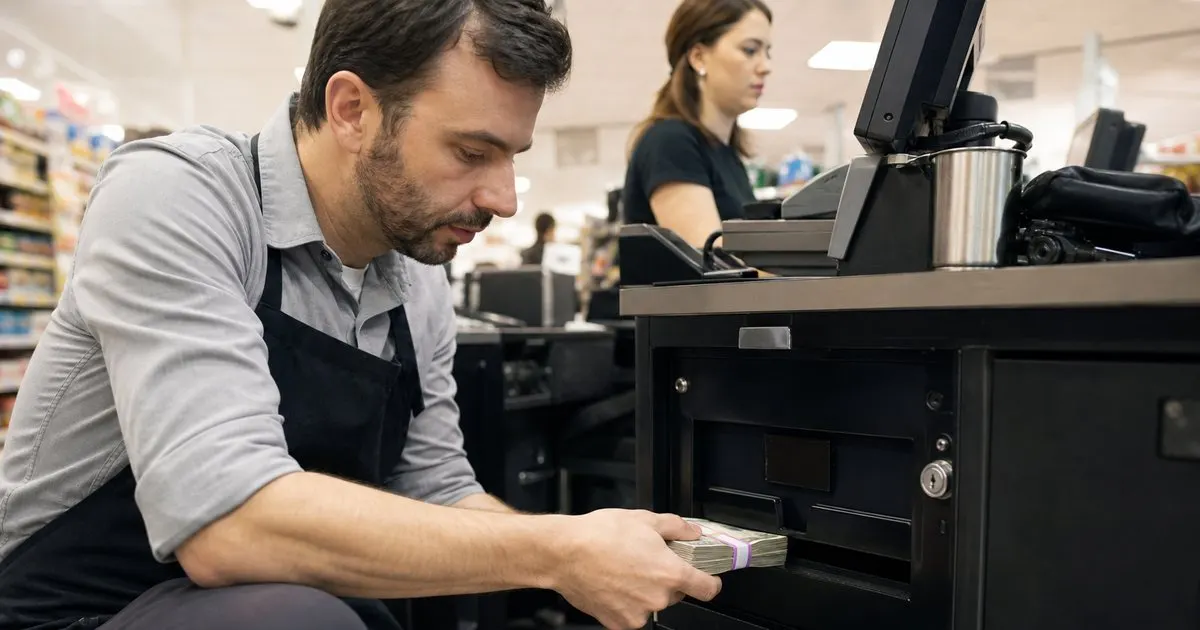
Set a drawer ceiling before the shift starts
The decision to pull a drop should not be a judgment call made at the register in the middle of a rush. Decide ahead of time how much cash a drawer is allowed to hold, write it down, and make it part of the opening routine. Many small stores land on a ceiling somewhere in the low hundreds above the starting bank, while higher-volume locations and bars tend to set it higher because pulling every hour would interrupt service. The right number depends on your ticket size, how much of your sales come in as cash, and how comfortable you are with what a single drawer would lose in a grab-and-run. Related: How do you run a guided cash drawer count that is right every time?
Once the ceiling exists, the trigger is simple. When the drawer crosses it, the next quiet moment is drop time. If your point of sale shows a running cash total per drawer, the cashier can see the number and flag the manager. If it does not, a practical fallback is counting the large bills in the drawer at natural breaks, such as after a lunch rush or at a shift change. The point is to remove judgment and guilt from the moment. A cashier should never feel like asking for a drop is admitting something is wrong.
Keep reading: How do you run a guided cash drawer count that is right every time?, How do you track over and short by cashier to find real problems?, How do you reconcile the till at end of day without a long headache?. See how TillClosr helps you cash drawer counts and end-of-day till reconciliation.
Pull large bills, leave the working change
A good drop removes risk without starving the drawer. Pull the twenties, fifties, and hundreds down to a sensible working level and leave the ones, fives, and coin alone. Those small denominations are what the cashier needs to make change, and if you take too many of them, you will be back at the drawer ten minutes later handing over a roll of quarters. Gather the large bills in one motion, count them once in front of the cashier, and band or envelope them immediately.
Resist the temptation to round the drop. If you counted $340 in large bills, drop $340, not $300 with a plan to remember the rest. Odd amounts are fine. What matters is that the drop amount you write on the envelope matches exactly what went into it, because that number is what the close will subtract from the drawer's expected cash later. Every rounded or estimated drop turns into a mystery variance at eleven at night. Related: How do you reconcile the till at end of day without a long headache?
Record the drop before the envelope leaves your hand
The single most common cause of a missing drop is a real drop that nobody logged. The manager pulls the cash, gets called to the floor, seals the envelope an hour later, and forgets to write it down. At close, the drawer is short by exactly that amount and everyone spends twenty minutes searching before someone opens the safe and finds it. Recording has to happen at the register, with the cashier watching, before anything else. Related: How do you track over and short by cashier to find real problems?
The record needs four things: the drawer or register, the time, the amount, and who pulled it. A paper drop log next to the safe works. A line item in the point of sale works better because it flows straight into the expected cash at close. Software like TillClosr treats each drop as an event on the drawer, so the closing count already knows to expect less cash and the drop total reconciles against what is physically in the safe. Whatever tool you use, the cashier should initial or acknowledge the drop too. That shared record protects both people.
Reconcile drops against the safe at close
Drops are only half done when they hit the safe. At close, someone needs to count the envelopes in the drop safe and match the total against the drop log for the day. If the log says four drops totaling $1,180 and the safe holds four envelopes totaling $1,180, the day is clean. If the count is off, you know immediately whether the problem is a drawer issue or a drop issue, which is far easier than discovering a general shortage with no clue where it came from.
Build the safe count into the closing checklist, not as an afterthought. On busy days with many drops, a running tally on the log sheet makes the final match quick. If your process has two people involved at close, have one read the envelope amounts while the other checks them off the log. This is also where you catch the honest mistakes: a drop written as $180 that was actually $130, or an envelope from yesterday that never made it to the deposit. Catching those the same night keeps the deposit accurate and the audit trail clean. Related: Why should you keep an accurate deposit log for every bank drop made?
- Decide the drawer cash ceiling before the shift and treat crossing it as an automatic trigger, not a judgment call.
- Pull large bills only, leave working change, and drop the exact counted amount rather than a rounded figure.
- Log every drop at the register with drawer, time, amount, and who pulled it, before the envelope goes anywhere.
- Count the drop safe at close and match it to the log so any variance is traced to a drop or a drawer right away.

Julien Jimenez
Julien Jimenez is an independent software builder based in Paris. He designs, ships, and operates focused SaaS products for small businesses and independent professionals. Read the full author page.
Close Every Drawer Right The First Time
Cash drawer counts and end-of-day till reconciliation. TillClosr is built to help you put this into practice.
Start free trialMore from the TillClosr blog
How do you run a guided cash drawer count that is right every time?
How do you track over and short by cashier to find real problems?

How do you reconcile the till at end of day without a long headache?
Get the TillClosr playbook
Practical guides on cash handling and close, straight to your inbox as we publish them. No spam, unsubscribe any time.